Tijeras Man Charged With Trying to Cast His Late Wife’s Ballot in 2024 Election: What the Court Record Shows
Patrick Perea, 62, of Tijeras, New Mexico, is charged with fraudulent voting over a ballot in his late wife’s name submitted in October 2024.
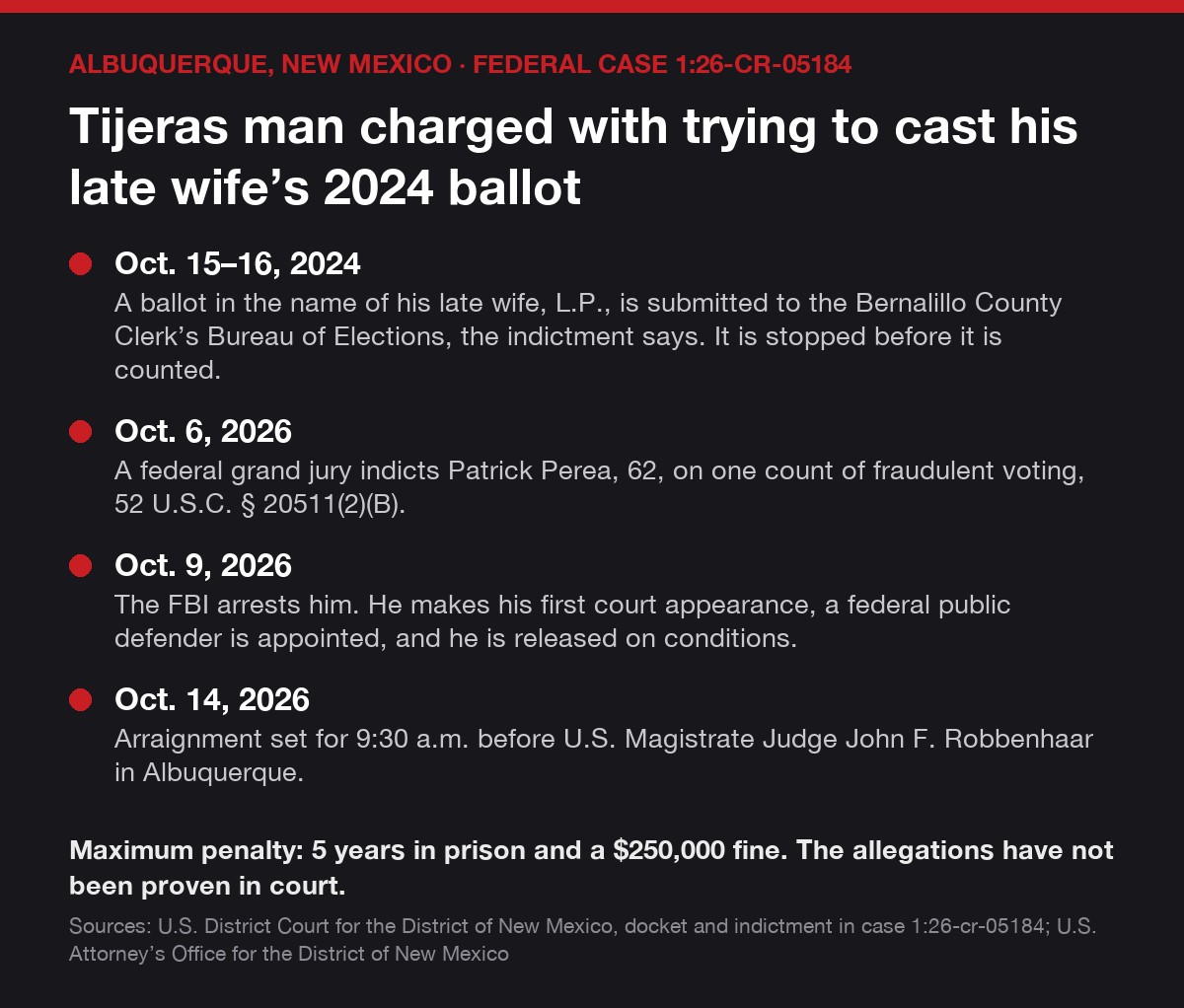
A Tijeras, New Mexico, man is charged in federal court with trying to cast his late wife’s ballot in the November 2024 general election, a ballot that election workers in Albuquerque stopped before it was counted, the U.S. Attorney’s Office for the District of New Mexico said.
Patrick Perea, 62, was indicted by a federal grand jury on Tuesday, Oct. 6, 2026, on one count of fraudulent voting. He was arrested on Friday, Oct. 9, 2026, and released the same day pending trial, according to the court docket and the Albuquerque Journal. If convicted, he faces up to five years in prison and a fine of up to $250,000.
What the indictment says
The indictment is one page long. It says that on or about Oct. 15, 2024, and Oct. 16, 2024, in Bernalillo County, Perea “knowingly and willfully deprived, defrauded, and attempted to deprive and defraud the residents of the State of New Mexico of a fair and impartially conducted election process.”
It says he did so because he “submitted and caused to be submitted a ballot in the name of L.P. to the Bernalillo County Clerk’s Office Bureau of Elections.” The indictment identifies his wife only by those initials. Read the redacted indictment (PDF).
The Justice Department credited the county clerk’s Bureau of Elections with “intercepting the ballot before it could be counted.” Neither the indictment nor the department’s announcement says how election workers spotted the ballot, how it was obtained, or which candidates were marked on it.
What the court record shows
The case, United States v. Perea, No. 1:26-cr-05184, was filed under seal and opened to the public on Oct. 9, 2026, the day of the arrest, the federal docket shows. It is assigned to U.S. District Judge Kea W. Riggs.
The arrest warrant was issued on Oct. 6, 2026, and an FBI special agent arrested Perea in Albuquerque on Oct. 9, 2026, according to the returned warrant. That morning he made his first appearance before U.S. Magistrate Judge John F. Robbenhaar, who appointed a federal public defender, Judith Bonilla, to represent him and signed an order setting his conditions of release.
The docket, last updated on Oct. 12, 2026, shows no plea.
The law he is charged under
The charge comes from Section 12 of the National Voter Registration Act of 1993, now 52 U.S.C. § 20511. Part (2)(B) makes it a federal crime, in any election for federal office, to defraud a state’s residents of “a fair and impartially conducted election process” through “the procurement, casting, or tabulation of ballots” that a person knows are “materially false, fictitious, or fraudulent” under state law. The law sets a maximum of five years in prison.
The law covers elections for federal office. New Mexico’s November 2024 general election ballot included the race for president.
How New Mexico takes dead voters off the rolls
New Mexico’s rules spell out how a voter who dies is supposed to be removed. Under the state’s election rule, 1.10.35.9 NMAC, the Secretary of State loads the list of deceased voters received from the state Department of Health into the statewide voter registration system. Each county clerk then has five business days to decide whether a death record is a “strong” or “weak” match with a voter on the rolls.
- A strong match is marked “removable,” with the reason “deceased.”
- A weak match has to be investigated further, and the clerk can ask the Secretary of State’s office for help.
- Clerks may also use local obituaries, probate records, death certificates or notarized statements from relatives to confirm a death.
The Secretary of State’s office says election administrators receive monthly reports from New Mexico Vital Statistics about people who have died and also check obituaries.
Prosecutors have not said where Perea’s wife’s registration stood in that process when the ballot arrived in October 2024.
What prosecutors said
“Dead people can’t vote,” First Assistant U.S. Attorney Ryan Ellison said in the announcement. “Casting a ballot that belongs to someone else is a deliberate abuse of our election process and a federal crime.”
The FBI’s Albuquerque Field Office investigated the case. Assistant U.S. Attorneys Sean J. Sullivan and Emil J. Kiehne are prosecuting it.
What happens next
Perea’s arraignment was set for 9:30 a.m. on Wednesday, Oct. 14, 2026, before Judge Robbenhaar in the Pecos courtroom of the federal courthouse in Albuquerque, according to the docket. At an arraignment, a defendant is formally told of the charge and enters a plea.
Perea is presumed innocent unless proven guilty. The allegations have not been proven in court.