Texas Mother Linked to Election Day ISIS Plot Deported in First-Ever Case Before Long-Dormant Terrorism Court
Nazira Haji Zada, 47, was deported to Afghanistan in the first case before the long-dormant Alien Terrorist Removal Court.
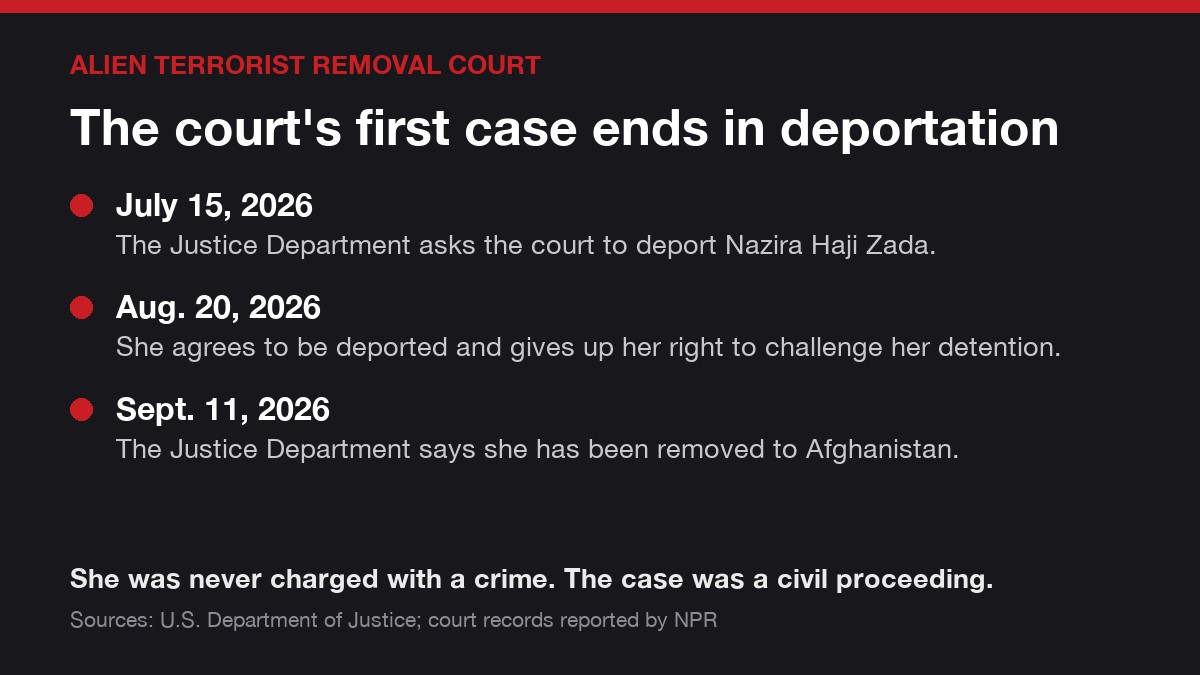
A Fort Worth green card holder was never charged with a crime. She agreed to be sent back to Afghanistan in the first case heard by a special court that had gone unused for 30 years. Her lawyers say they were never shown the classified evidence against her.
A 47-year-old Afghan woman who lived in Fort Worth, Texas, as a lawful permanent resident has been deported to Afghanistan. Hers is the first case ever heard by the Alien Terrorist Removal Court (ATRC), a special federal court that Congress created in 1996. No administration had used it until this summer.
The Justice Department announced on Friday, Sept. 11, 2026, that Nazira Haji Zada had been removed from the country. With her attorneys, she admitted that she counts as an “alien terrorist” under the law and gave up her right to appeal. That ended her permanent resident status, and she is now permanently barred from returning to the United States.
Haji Zada came to the U.S. as a permanent resident in 2018 and was never charged with a crime. Her case was a civil deportation proceeding, not a criminal prosecution. According to court records reported by NPR, her admission cannot be used against her in a criminal case.
Timeline of the case
- July 15, 2026: The Justice Department filed its request to deport her. Todd Blanche, then acting attorney general, had signed off on it. The Senate confirmed him as attorney general on Aug. 8, 2026.
- Late July: She was arrested at her Fort Worth home.
- July 30, 2026: The court held its first-ever public hearing, in Washington, D.C., before Chief Judge Joan N. Ericksen, who normally sits as a federal judge in Minnesota. Ericksen turned down the defense’s request to free her, and she stayed in custody.
- Aug. 20, 2026: Haji Zada agreed to be deported and gave up her right to challenge her detention. Judge Ericksen signed the removal order the same day.
- Sept. 11, 2026: The order and related court filings were made public. They had stayed sealed until she arrived in Afghanistan.
How the court works
The ATRC is made up of five federal judges from different parts of the country, appointed by the Chief Justice of the United States. It lets the government deport non-citizens it labels terrorists using classified evidence that is kept secret when releasing it would put national security at risk. The government only has to prove its case by a “preponderance of the evidence,” meaning more likely than not. That is a much lower bar than “beyond a reasonable doubt” in a criminal trial. Either side can appeal to the U.S. Court of Appeals for the D.C. Circuit.
The Justice Department said it used classified information to show that Haji Zada is a terrorist. It also said it gave her and her lawyers about half a terabyte of other documents supporting its case, and the government filed an unclassified summary of its allegations. People facing the court cannot review the classified evidence itself and, unlike criminal defendants, cannot challenge how that evidence was gathered.
The Election Day plot behind the case
The case grew out of a foiled 2024 terror plot hatched in Oklahoma.
On Oct. 7, 2024, federal authorities arrested her son-in-law, Nasir Ahmad Tawhedi, an Afghan national living in Oklahoma City, and her son, Abdullah Haji Zada, who was 17. The two were arrested at a rural spot in Oklahoma right after buying two AK-47-style rifles and 500 rounds of ammunition from an undercover FBI employee. Prosecutors said they planned an ISIS-inspired mass shooting on or around Election Day, Nov. 5, 2024. The plot was stopped before any attack.
Neither man went to trial. Both pleaded guilty in federal court in Oklahoma City:
- Abdullah Haji Zada was prosecuted as an adult. He pleaded guilty in April 2025 to receiving guns and ammunition for use in a terrorism crime. In November 2025 he was sentenced to 15 years in federal prison, the maximum for that charge.
- Tawhedi, now 28, pleaded guilty in June 2025 to trying and conspiring to provide material support to ISIS, and to a related firearms charge. He faces up to 35 years in prison but has not been sentenced. In February 2026, after a court-ordered psychological evaluation, U.S. District Judge Scott Palk ruled him mentally incompetent to be sentenced. Palk ordered more evaluation and treatment at a federal prison medical facility.
As part of their plea deals, both men agreed to be deported to Afghanistan after serving their sentences.
What the government accused her of
Federal officials called Haji Zada the family’s matriarch and said she supported the attack plan. According to government filings described by the Justice Department, NPR and NBC News, prosecutors alleged that:
- she pledged loyalty to ISIS and, with her son-in-law, pushed her children to adopt the group’s beliefs and swear loyalty to it;
- while the family sold furniture, computers, a phone and both cars to raise money, she signed a contract to sell the family home;
- the family bought one-way tickets to Kabul for her and her younger children, but not for Abdullah or Tawhedi, so they could leave before the attack. Prosecutors said she hid the plan from her husband, who had worked at Bagram Air Base in Afghanistan from 2009 to 2016.
These allegations were never tested in a criminal trial, and her lawyers say they were not allowed to see the classified evidence behind them.
Officials: a national security win
Attorney General Blanche called the outcome a landmark case and a win for national security and the rule of law. He said supporters of terrorism should not live in the United States and that the department would use every tool it has. FBI Director Kash Patel called the removal historic. Assistant Attorney General for National Security John A. Eisenberg said Haji Zada had been a clear threat to national security. Homeland Security Secretary Markwayne Mullin said the government would use every lawful tool to remove people who plot terrorism against the country.
Defense: agreeing to leave is not approval of the court
Haji Zada’s court-appointed lawyers, federal public defenders Matthew Farley and Mary Manning Petras, issued a statement after the order was made public. They said her agreement to leave “should not be seen as an endorsement of this court’s legitimacy.”
They argued that hauling permanent residents into court while refusing to show them or their lawyers the evidence against them violates the Constitution’s due process guarantee. They predicted the ATRC will be struck down as unconstitutional once a judge rules on the question. At the July 30, 2026, hearing, Farley argued that the proceeding violated several of her constitutional rights and asked the judge to throw out the case. Right up to her deportation, the defense was pressing the court to make the Justice Department share its evidence.
Because Haji Zada agreed to removal and gave up her appeal, her case ended before any court ruled on whether the ATRC is constitutional. That question remains open for the next person brought before it.